
Trade War vs. 3.2% Growth: What OECD Missed - Trade War? (Think Again)
The OECD's Rosy Outlook: A Grain of Salt (and a Shovel of AI)
Upbeat Forecast, But Proceed With Caution
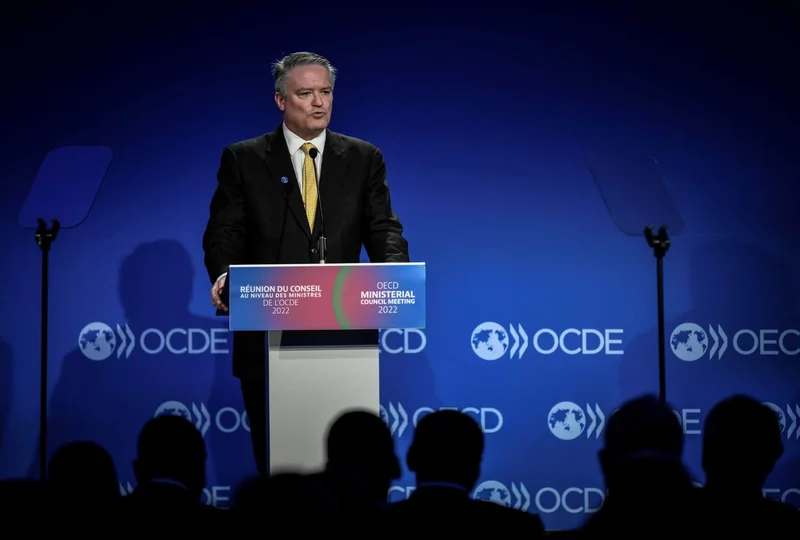
The Organization for Economic Cooperation and Development (OECD) just released its latest global economic forecast, and the headline is surprisingly upbeat: 3.2% growth expected this year, a slight dip from last year's 3.3%, but a definite improvement from their earlier, more pessimistic predictions. Despite US trade war, OECD expects global economy will grow 3.2% this year They’re even upgrading their U.S. growth forecast to 2%, up from 1.6% back in June.
Now, I've been staring at economic forecasts long enough to know that these numbers are more like weather predictions than immutable truths. Still, let's unpack what's driving this relative optimism, because the devil, as always, is in the details.
Key Factors Driving Optimism
The OECD is pointing to a few key factors. First, President Trump's trade war – a constant source of anxiety – hasn't had the catastrophic impact many feared. The tariffs, while disruptive, haven't been as high as initially threatened, and companies have found ways to mitigate their impact (like front-loading imports before the tariffs kicked in). Second, and perhaps more significantly, the OECD cites "massive investments in artificial intelligence" as a major growth driver.
The AI Savior? A Skeptical View
That last point is the one that really caught my eye. AI as an economic savior? It sounds a bit too… convenient. It's like saying the dot-com boom was all about better banner ads. Sure, AI is generating buzz and attracting investment, but is it really contributing enough to offset the drag from trade tensions and broader economic uncertainty?
I'm not so sure.
Underlying Concerns and Volatility
The report itself acknowledges that higher tariffs will eventually translate to higher prices, dampening consumer spending and business investment. So, while the immediate impact might be muted, the long-term consequences are still lurking. And let's not forget the inherent volatility of the AI sector. What happens when the hype cycle cools down? What happens when the regulatory hammer finally drops, as it inevitably will?
Regional Performance and Methodological Questions
The OECD also highlights the performance of specific economies. China is expected to maintain its 5% growth rate (the same as in 2024), while India is projected to grow even faster, at 6.7%. The Eurozone, however, remains sluggish, with a projected growth rate of just 1.3%. (That’s up from 0.8% last year, but still hardly cause for celebration.)
Here's where I start to question the methodology. How much weight is given to these individual country forecasts when calculating the overall global growth figure? A strong performance from India, for example, can mask underlying weaknesses in other regions. And are these forecasts adequately accounting for potential geopolitical risks, like escalating tensions in Eastern Europe or renewed trade disputes?
Economic Forecasting: An Inexact Science
I've looked at hundreds of these reports, and while I respect the OECD's expertise, I always take their projections with a healthy dose of skepticism. Economic forecasting is, at best, an inexact science. It's more like trying to predict the path of a hurricane based on a handful of weather balloons.
Is This Just AI Hype?
The persistent focus on AI as a buffer against economic headwinds feels… forced. Are we really pinning our hopes on algorithms and machine learning to save us from a trade war of our own making? It's a bit like trying to fix a leaky dam with duct tape and a prayer.
Limitations of Technological Advancements
While technological advancements are undoubtedly important, they're not a magic bullet. They can't solve fundamental problems like trade imbalances, protectionist policies, and regulatory uncertainty. And they certainly can't guarantee sustained economic growth.
Potential Downside Risks
The OECD's forecast might be accurate, but it's also important to consider the potential downside risks. A sharper-than-expected slowdown in China, a resurgence of inflation, or a major geopolitical shock could all derail the global economy. And if that happens, those rosy AI-fueled projections will quickly become a distant memory.
Reality Check: A Sugar Rush
Here's the unvarnished truth: the OECD's upgraded forecast is more of a sugar rush than a sustainable recovery. It's a temporary reprieve fueled by short-term factors and overly optimistic assumptions. The underlying problems are still there, and they're not going away anytime soon. The global economy may be "resilient," as the OECD claims, but it's also fragile. And relying on AI to paper over the cracks is a dangerous game. It's like betting the farm on a single, unproven technology. The potential payoff might be huge, but the risk of failure is even greater.
Why Crypto's Volatility Forges a Resilient Future - Twitter Reacts
Next PostThis is the latest post.
Related Articles